
Article: Sunstone meaning, properties and natural stone jewellery
Sunstone meaning, properties and natural stone jewellery


Sunstone, also known as heliolite, is a luminous gemstone with shimmering, coppery reflections. Prized in jewellery, it appeals through its warm glow and the particularly elegant effect it creates alongside gold-tone stainless steel.
👉 Explore our natural stone jewellery to discover the colours and combinations in our selection.
But what is sunstone? What meaning is associated with it, and how do you choose and wear it? This guide brings together information on the mineral, its symbolism and useful everyday care.
It may seem subtle in a photograph, then a movement of the wrist reveals a small coppery flash. Sunstone has that lively charm: it follows a gesture without demanding attention. In jewellery made with fine beads, its peach, cream or orange shades create a gentle composition whose details reward a closer look.
What is sunstone?
Sunstone belongs to the feldspar group. Its sparkling varieties owe their reflections to tiny reflective inclusions: notably iron minerals in some stones, and copper in Oregon sunstone.
These flashes give the stone depth. The sparkling phenomenon is called aventurescence; it differs from the simple shine of a polished surface.
To observe the effect, simply move the jewellery under soft light. Reflections may become more visible from particular angles. A bead’s facets also create their own play of light. A brightly lit photograph therefore tells only part of the story: look at several views, a video where available, and the actual size of the components.
The name sunstone can refer to different feldspar varieties. It guarantees neither a uniform colour nor a single origin. A softly peach-coloured bead and a more coppery gem can look quite different; a good choice starts with the appearance you enjoy.
Where does sunstone come from?
Deposits are known in several countries, including:
- India
- Norway
- Canada
- United States
Shades and intensity of reflection vary with the deposit and variety. This list describes places where the mineral occurs; it does not establish the origin of the stones in a particular piece of jewellery.
Why is it called sunstone?
Its name evokes sunlight and the warmth of its reflections. This resemblance inspires symbolic associations with energy, vitality and joy, separate from its mineralogical characteristics.
Sunstone meaning and attributed properties
In crystal-healing beliefs, sunstone is regarded as an uplifting symbol. Associations include:
- joy in life
- self-confidence
- optimism and creativity
- symbolic protection from negative energies
These associations can give personal meaning to a gift or to jewellery worn as a reminder of an intention. They are not demonstrated therapeutic effects. A stone does not treat fatigue or a health condition; its symbolism can be appreciated without expecting it to act on the body or mood.
Why choose sunstone jewellery? ✨
Sunstone jewellery is appreciated for its natural glow and the way it catches the light. Part of its appeal lies in the visible variations between individual beads.
- warm, luminous colour
- shimmering reflections that vary with the stone
- an attractive pairing with gold-tone finishes
👉 Whether worn in a bracelet, necklace or earrings, sunstone adds a sunny, elegant touch. Your choice then depends on the designs available and your own habits.
👉 Discover the Luzia sunstone bracelet, a way to add texture and interest at the wrist.
How do you wear sunstone?
Sunstone can help you:
- brighten a neutral outfit
- bring warmth to a minimalist look
- create a bright focal point with one main piece
Its shades work particularly well with fine-gold-plated stainless steel.
Against a white shirt or an ecru jumper, a small-beaded bracelet lets the material and colour speak. With beige, natural linen or warm brown, the look stays harmonious. Against navy, the contrast is stronger: the peach detail becomes more visible without needing a large piece of jewellery.
When stacking pieces, choose a common thread: the same gold-tone finish, similar thickness or a single colour family. Leave some space between bracelets so that metal elements do not constantly rub against the stones. If you already wear large earrings, a lighter arrangement at the wrist keeps the overall look clear.
Which zodiac signs is it associated with?
Some symbolic traditions associate it with the fire signs:
- Leo ♌
- Aries ♈
- Sagittarius ♐
These correspondences vary between authors and do not determine who can wear the stone. Your zodiac sign need not guide your choice: colour, shape and the pleasure of wearing the piece are enough.
Which chakra is sunstone linked to?
In some spiritual practices it is linked to the solar plexus chakra, symbolically associated with vitality, confidence and energy. This is a belief framework, rather than a physical property of feldspar.
How do you cleanse and recharge sunstone?
The following practices are symbolic rituals. They are not needed to maintain the mineral’s properties and do not replace physical cleaning of the jewellery.
Symbolic cleansing:
- fumigation, sometimes practised with sage or palo santo
- sound used as a ritual aid
- personal intention
Symbolic recharging:
- gentle sunlight, according to some beliefs
- placement near a quartz cluster
- placement near an amethyst geode
Avoid salt water, sudden temperature changes, heat and any contact with flames or ash. Do not rub the jewellery against other stones: a ritual should not damage it.
When can you wear sunstone jewellery?
- in the morning, for the pleasure of choosing a bright detail
- on a day when you want a warm colour, without expecting it to relieve fatigue
- with an outfit chosen for a creative project
- in summer, when its shades complement lighter fabrics
Why pair sunstone with gold-tone stainless steel?
At Djanet Bijoux, this combination is chosen to:
- highlight its reflections
- pair the stone with a steel structure, while respecting each material’s care needs
- create a luminous, elegant finish
Which sunstone jewellery should you choose?
When comparing jewellery styles, consider:
- bracelets, to see the shades as your wrist moves
- necklaces, when a suitable design is available
- earrings, for a detail close to the face
Each shape shows the stone differently. Among our designs, the Luzia bracelet and Lyna hoops offer two examples of this pairing with gold tones.
Two examples: Luzia at the wrist, Lyna near the face
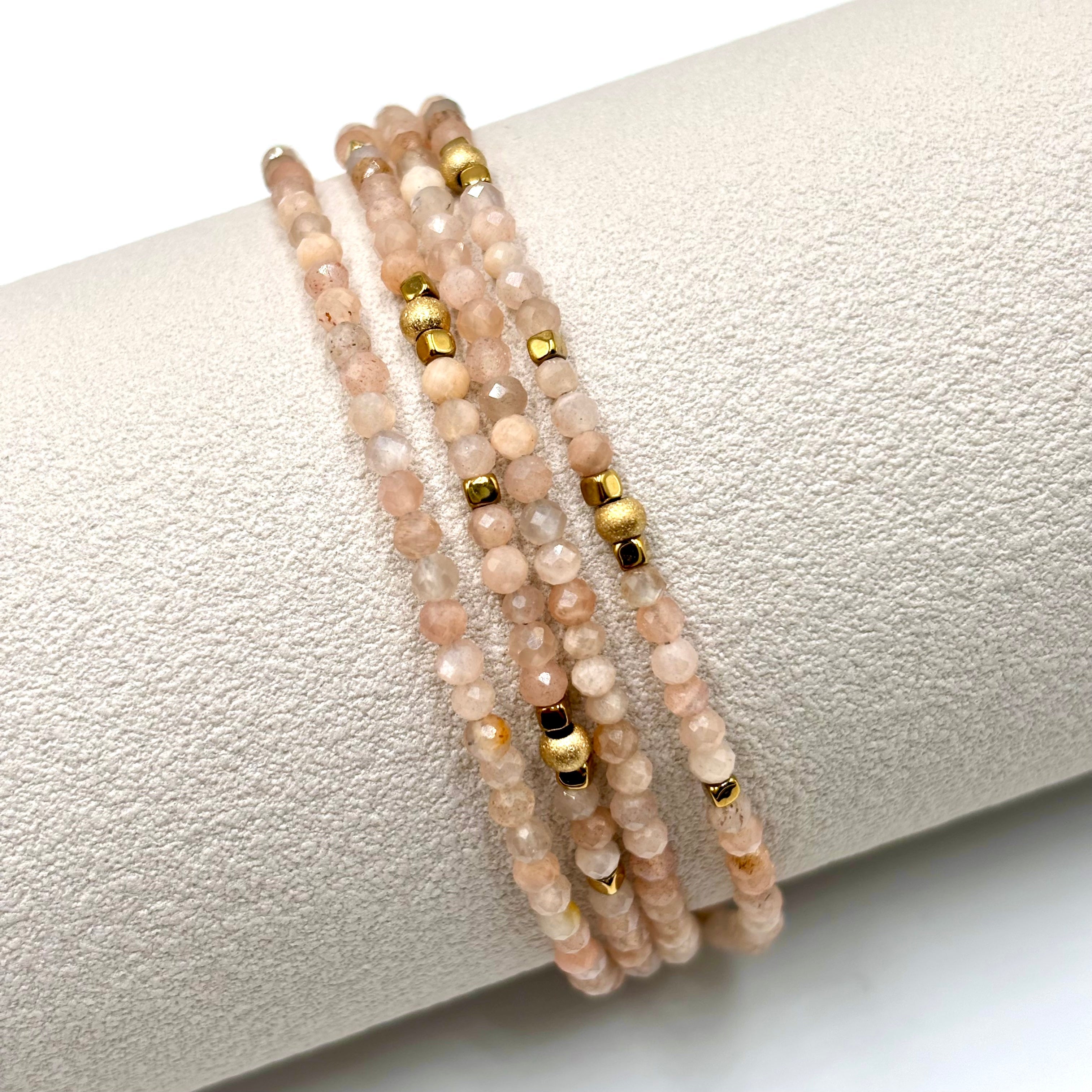
The Luzia bracelet combines four rows of 2.6 mm faceted sunstone beads, 2 mm gold-tone haematite beads and 3 mm sand-textured gold-tone steel beads. Its double-wrap construction gives it a fuller presence than a single strand while keeping the components small. The product page states a total length of 32 cm, including the clasp, with a 5.5 cm extension. Measure your wrist and allow for the two wraps before choosing the adjustment.
The Lyna sunstone hoop earrings offer a different balance: their product page states 30 × 30 mm, with a thickness of 5 mm. Consider these dimensions near your face and your usual hairstyle, whether worn loose or tied back. These measurements describe the designs; they do not replace looking at how the jewellery appears when worn.
For designs currently offered, browse our earrings collection. Availability may change.
How can you recognise genuine sunstone?
Goldstone is a common imitation: manufactured glass containing small copper crystals. It can be attractive, but should not be confused with natural feldspar. Sparkle, a cool feel or irregularities do not, by themselves, prove a stone’s authenticity.
Ask for a precise material description, any declared treatments and its origin where known. If identification is particularly important to your purchase, a gemmologist can provide a more reliable answer than a home test. Avoid scratching, heating or applying acid to the jewellery. When comparing prices, also consider dimensions, finish, other materials and construction: two pieces bearing the same stone name are not necessarily equivalent.
How do you care for sunstone jewellery?
- avoid knocks and repeated rubbing
- start with a soft, clean, dry cloth
- store separately in a dry place after wearing
Resistance to scratching and resistance to impact are different things. Feldspar can split along certain planes: remove a bracelet before sport, gardening or manual work. Steel does not automatically protect the beads, their attachments or gold-tone finishes.
For persistent dirt, first check the instructions for the complete design. GIA recommends warm, soapy water for sunstone, but assembled jewellery can include components that need different precautions. If the manufacturer permits it, use a slightly damp cloth, then dry carefully without soaking. Avoid ultrasonic cleaners, steam, bleach and household cleaning products. Individual storage reduces rubbing against other jewellery.
👉 Read our guide to caring for gold-tone stainless steel jewellery.
Frequently asked questions about sunstone
What is the difference between sunstone and moonstone?
Both belong to the feldspar group, but their optical effects differ. Sparkling sunstone varieties display reflective points or flashes; moonstone can show a softer glow called adularescence. They are not two names for the same stone.
Does sunstone need sunlight to sparkle?
No. Its reflections appear when light meets the inclusions at a favourable angle. They do not come from energy stored through recharging. Prolonged exposure to heat is not helpful for the jewellery.
Gemmological references: GIA’s mineral description, goldstone imitations and care guidance.
Choose sunstone for its light and character
With its warm shades and changing reflections, sunstone adds depth to both understated jewellery and bolder pieces. Take time to consider its colour, the design and its comfort: these details make a piece one you want to keep wearing.
✨ Explore Djanet Bijoux sunstone jewellery and discover its natural glow.