

Stainless steel jewellery: the complete guide
Gold-coloured stainless steel: an ideal partner for everyday jewellery
Shiny, resistant and easy to live with, stainless steel has become a leading material in modern jewellery. Jewellery made from 316L stainless steel is increasingly appreciated for its resistance, lustre and excellent value for money.
But why choose it for your jewellery? How does it differ from other metals? Is it suitable for sensitive skin? We answer your questions about this material that combines elegance with durability.
Discover our Djanet Bijoux jewellery collections
What is stainless steel and why is it used in jewellery?
Stainless steel is an alloy made mainly from iron and chromium, with other elements depending on the grade. Chromium helps form a thin protective layer on the surface, which explains its good corrosion resistance. This protection is one of steel’s strengths, without making it impervious to every condition of use.
At Djanet Bijoux, we select premium stainless steel jewellery with a gold-coloured PVD finish to combine strength, lustre and refinement. The metal forms the base of the piece; its finish gives it its golden colour. Understanding this distinction helps you choose and care for it.
What are the advantages of stainless steel jewellery?
Stainless steel has established itself as one of the best materials in modern jewellery. It combines durability, appearance and comfort, making it an appealing choice for pieces worn every day.
- Good resistance to moisture: occasional water contact is not the same as repeated exposure to salt, chlorine or shower products; drying the jewellery remains a good habit.
- Easy-to-maintain shine: a soft cloth removes everyday marks; the durability of the golden colour also depends on the coating and friction.
- A possible choice for sensitive skin: composition and nickel release matter more than a general promise of “no allergies”.
- A recyclable metal: this property concerns the steel itself; stones, assembly methods and collection systems also matter when recycling jewellery.
- Excellent value for money: a refined appearance at an accessible price
It is one of today’s most appealing combinations of appearance, durability and practicality.
Explore our collection of gold-coloured stainless steel rings
What is a gold-coloured PVD coating, and does it always contain real gold?
PVD, short for Physical Vapor Deposition, is a vacuum deposition process used to create certain decorative coatings. It can give steel a resistant gold-coloured finish. The term “PVD” therefore describes a technique; on its own, it specifies neither the exact composition of the coating nor a gold fineness.
Not every gold-coloured PVD coating necessarily contains real gold. Some use compounds such as titanium nitride to achieve this colour. That alone does not make them fragile: durability depends on the coating as a whole, how it is produced and how the jewellery is worn.
When choosing, distinguish the colour, process and stated composition. A “14K” description does not mean that the entire piece is made from solid gold. At Djanet Bijoux, we select premium stainless steel jewellery with a gold-coloured PVD finish. Each product page gives details of its material and finish.
Discover our gold-coloured stainless steel necklaces
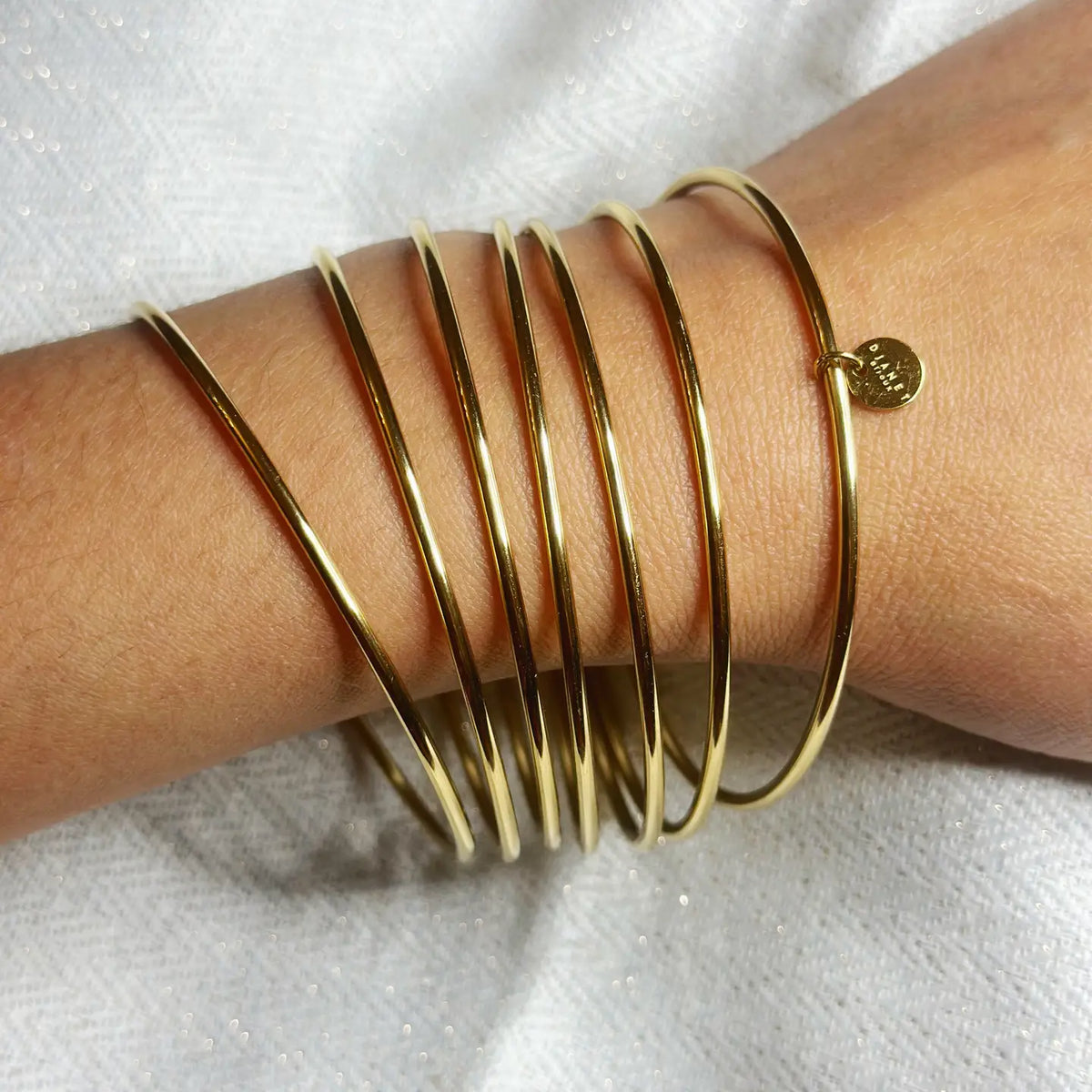
Discover our gold-coloured stainless steel bracelets
How does gold plating differ from gold-coloured PVD stainless steel? Which lasts longer?
These terms do not describe exactly the same thing: stainless steel refers to the base metal, while plating describes a coating. Gold-coloured steel jewellery also has a surface finish. Comparing pieces becomes more useful when you look at the base, coating and conditions of wear.
🔸 Gold plating:
A layer of gold covers a base metal. Its durability depends on factors including thickness, quality and friction. A ring worn on the hand and a pendant do not experience the same stresses.
🔹 Gold-coloured PVD stainless steel:
A gold-coloured coating is deposited onto a steel base. Careful production can offer good resistance to wear, but does not make the jewellery indestructible or scratch-proof.
To choose between two pieces, think about how you will wear them. A necklace against the skin, a bracelet rubbing on a desk and a ring exposed to handwashing will not have the same care needs.
Why does some gold-coloured stainless steel jewellery look too yellow?
A very yellow colour can depend on several factors:
- the composition and shade of the coating
- the surface finish, whether shiny, satin or more matt
- the lighting, surrounding colours and the photograph itself
The shade of gold is therefore not proof, on its own, of quality or real gold content. To create harmonious combinations, look at the jewellery in natural light and consider how its colour works with the pieces you already wear.
Is stainless steel suitable for sensitive skin?
Stainless steel can suit many people, but skin sensitivity is individual. The term “hypoallergenic” does not guarantee that nobody will react. If you have a known metal allergy, the design’s composition and available information on nickel release are useful points to consider.
Does stainless steel jewellery contain nickel?
Some common grades, including 316L, contain nickel. Its presence in the alloy and its release when touching the skin are different things. In the European Union, REACH restricts nickel release for relevant articles intended for direct, prolonged skin contact.
Look for documented information on
nickel release and compliance with the applicable limits, rather than an unexplained “nickel-free” claim.
Can stainless steel jewellery tarnish or rust?
Stainless steel resists corrosion thanks to its protective layer, but “stainless” does not mean “impossible to damage”. Salt, chlorine and certain harsh products can challenge that protection. A colour change on gold-coloured jewellery may also affect the coating rather than the metal itself.
Can stainless steel jewellery get wet?
Steel, particularly grades such as 316L, has good corrosion resistance. But jewellery is not just a piece of metal: its finish, stones, pearls and glued components may need more careful treatment.
The simplest approach is to remove jewellery before swimming and showering to protect the whole piece. After occasional water contact, dry it gently. For mother of pearl, pearls and natural stones, follow the design’s own care advice rather than routinely rinsing or soaking it.
Surgical steel and 316L steel: what you should know
The expression “surgical steel” is often used for certain steels employed in medical applications. Yet it does not, on its own, identify a precise grade, standard or intended use. For jewellery, clearly stated composition is more informative than a label alone.
316L is a low-carbon grade of stainless steel. It belongs to a family containing chromium, nickel and molybdenum. The L refers to its low carbon content; it does not mean “nickel-free” or “no allergy risk”.
316LVM is associated with vacuum processing and certain medical applications, according to the material specification. This does not turn jewellery into a medical device: intended use and manufacturing requirements remain different.
In summary:
- 316L: a low-carbon grade used in jewellery, among other applications
- surgical steel: an expression that needs a specific grade and intended use
- 316LVM: a designation associated with vacuum processing and specific material requirements
For Djanet Bijoux jewellery, consult the characteristics of your chosen design. We favour clear information about material and finish so you can compare pieces on concrete details.
Are there different qualities of stainless steel?
Yes. Grades correspond to different compositions and uses, rather than a universal ranking from “worst” to “best”:
- 304: a common grade in the chromium-nickel steel family
- 316: a grade containing molybdenum, which improves resistance to certain forms of corrosion
- 316L: a low-carbon version of the 316 family
Jewellery quality also depends on how it is made. An even chain, a well-adjusted clasp, smooth edges and neat stone settings are details you appreciate every day, whatever the material label says.
What explains price differences between stainless steel jewellery?
Prices can vary according to:
- the quality of the steel
- the type of gold-coloured finish
- the natural stones
- the finishing
How do you care for stainless steel jewellery?
- Wipe the jewellery with a soft cloth to remove fingerprints and traces of cream.
- For a simple metal design, use a little soapy water only if its care instructions allow it, then dry thoroughly; decorative elements may need a different method.
- Store pieces somewhere dry, separately from each other to limit rubbing and snagging.
Tip: keep your jewellery in a soft pouch to prevent rubbing.
Conclusion: why choose stainless steel jewellery?
Stainless steel has become an established choice in jewellery. Resistant, lasting and easy to care for, it meets the expectations of modern jewellery.
Combined with a quality gold-coloured PVD finish, it creates elegant, reliable jewellery made to last. Looking after the coating and considering how you wear the piece matter as much as the choice of metal.
At Djanet Bijoux, we love premium gold-coloured stainless steel jewellery, natural stones and personalised pieces that find their place in a personal story. Above all, choose a design you will want to wear often, then give it a little simple care to preserve its beauty.
Discover our gold-coloured stainless steel jewellery
Further technical reading: stainless steel corrosion resistance (Outokumpu), decorative PVD coatings (Ionbond) and the REACH nickel restriction (ECHA).


