

Jewellery engraving ideas: meaningful words for necklaces and bracelets
You have found the jewellery. You have chosen the chain, the pendant, perhaps even the font… then you reach the little box marked “Text to engrave”.
And suddenly, you hesitate.
A name? A date? Initials? A word? A sentence? Your children’s names? And if both sides can be engraved, what should go on the front and back?
Choosing what to engrave on jewellery can take more thought than choosing the jewellery itself. Sometimes just a few characters need to tell the story of a birth, a meeting, a family, a friendship or a memory you want to keep close.
The good news is that a beautiful engraving does not need to be complicated.
A name can be enough. A date known to just two people can tell a whole story. An initial can represent someone without revealing their identity. And a few simple words can mean far more than a long quotation found online.
So, what should you engrave on personalised jewellery? Here are our ideas and, above all, our advice for choosing an engraving that truly means something to you.


What can you engrave on jewellery?
A name or initials evoke a person; a date preserves a moment; a short word expresses a feeling. To decide what to engrave, start with that meaning, then adapt the inscription to the jewellery’s surface and options. The engraving ideas below offer inspiration, rather than texts that fit every design.
When you think of engraved jewellery, a name often comes to mind first. It is a timeless choice, but far from the only possibility.
An engraving can represent a person through a name, initials or nickname. It can preserve a moment through a date. It can express a feeling through a word or short message. It can also remain deliberately mysterious, using a few numbers or an inscription whose meaning only you understand.
The first question is therefore not necessarily “What would look pretty?”, but rather:
What would I like to remember each time I look at this piece?
This question often helps you put aside impersonal ideas and find an engraving that feels more fitting.
If you want to focus on a person, a name or initial comes naturally. If you want to preserve a particular memory, consider a date. If the jewellery should express a feeling or thought, a few words can be enough.
Name, date, initials or message: how do you choose?
These four options are common, but they do not tell the same story.
A name is direct and immediately recognisable. It puts the person it represents at the centre.
Initials are more discreet. They can symbolise a person, couple or several family members without making their meaning obvious to others.
A date represents a moment. It works particularly well for private personalisation: others see a few numbers, while you may remember an important day in your life.
A message expresses a feeling. Contrary to what you might think, it does not need to be long to be powerful.
“Always” can sometimes say more than several lines.
This is one of the first things to remember when choosing an engraving: on jewellery, a few words can tell a great deal.

Engraving a name: a timeless way to personalise jewellery
Engraving a name sounds simple. Yet behind that name, there is almost always a story.
A mum might wear her child’s name, a grandmother those of her grandchildren. A woman might choose the name of someone she loves, her sister, her best friend or simply her own name.
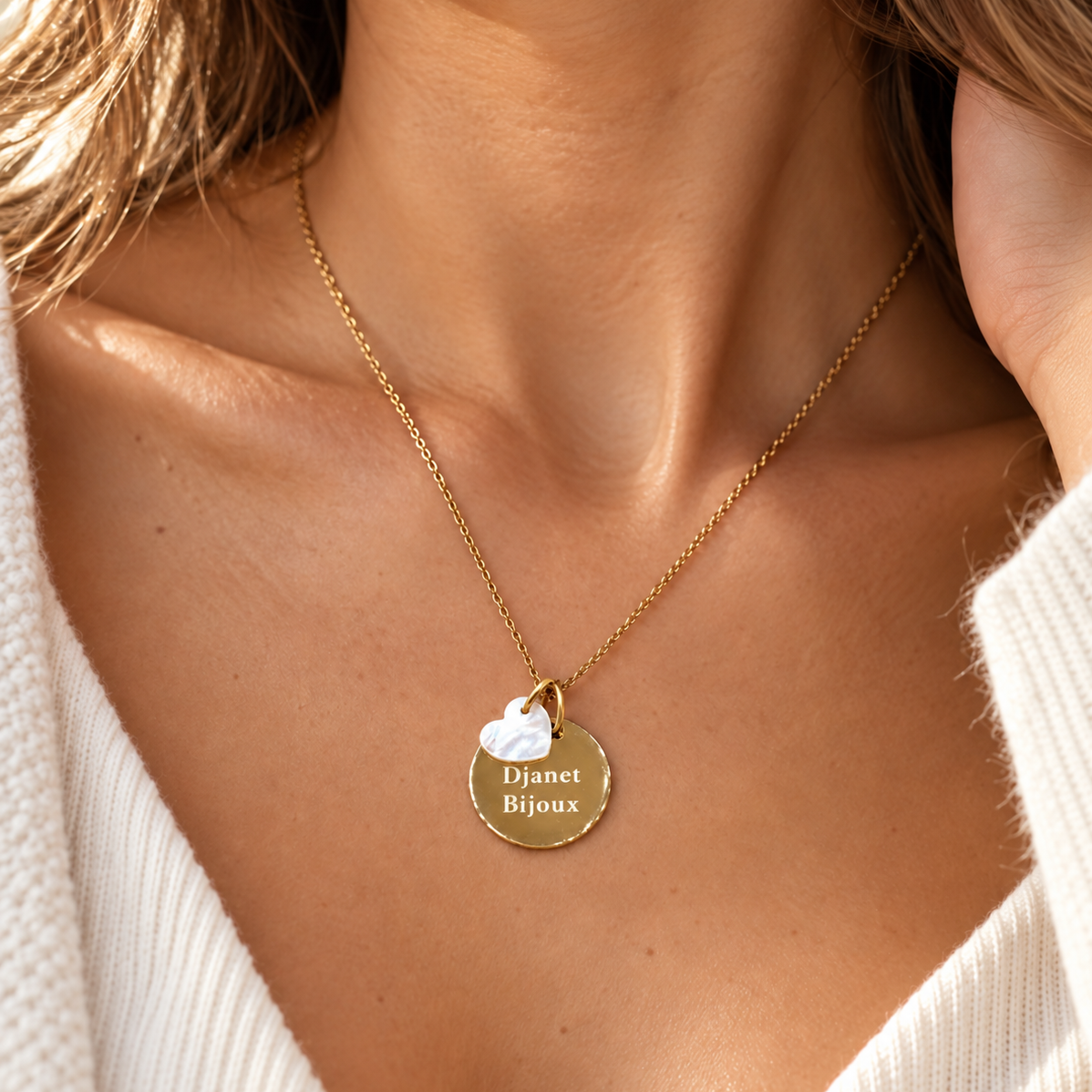
On a round disc, the name can become the main feature. It is no longer just an inscription: it becomes part of the jewellery’s appearance.
With several names, however, avoid trying to fit them all onto one small disc at any cost.
A bracelet with several charms may, for example, give each child a separate disc. The composition becomes more balanced and every name keeps its own space.
Some personalised engraved bracelets offer this possibility, allowing you to build a piece around several members of the same family.
Which date should you engrave on jewellery?
A date can be one of the most discreet and personal engravings.
A child’s birth date, your first meeting, wedding, engagement, anniversary or another important occasion: a few numbers can hold an entire memory.
And you do not have to choose an “official” date.
The day of an unforgettable trip, an important decision or simply a date whose meaning only you know can matter as much as a wedding day.
The chosen format also contributes to the engraving’s style.
07.01.2026 is very readable.
07/01/26 is more compact.
07 • 01 • 26 gives a more graphic layout.
Roman numerals can also give a date a more coded appearance. If you choose them, check the conversion carefully before submitting your engraving text.
A date can also work well on the back of a pendant: it may remain against the skin, known only to its wearer.
To avoid ambiguity, read the date in words before typing it. In day/month/year order, as commonly used in the UK, 07/01/26 means 7 January 2026. If the recipient is used to a different date order, make sure your choice is understood. Separators and Roman numerals remain subject to the characters offered for the design.


Initials or a name: which personalisation is more discreet?
If you like personalised jewellery but prefer not to display a full name, an initial is an excellent alternative.
A single letter can represent your own name or someone dear to you.
Two letters can evoke a couple, two children, two sisters or a friendship.
Several initials can represent a whole family.
That simplicity is precisely the appeal of an initial. Others see a letter; its wearer may see someone essential to her life.
Personalising with an initial does not always require engraving. A letter pendant gives the same symbolic idea a different appearance.
If you like this kind of personalisation, explore our initial necklaces for women and personalised initial bracelets.
To compare chains, cords and letters for the wrist, our initial bracelet guide explains styles and fit. Here, the focus remains choosing the inscription: the piece and the message complement one another.
Which word should you engrave on jewellery?
This is often the point where you start searching online for dozens of ideas.
Before choosing a ready-made phrase, however, try returning to your own story.
Is there a word this person often uses? A nickname only you call them? A family expression? A place name? A word tied to a memory? A short phrase you have said to each other for years?
These are often the inscriptions that make jewellery truly personal.
To offer a few starting points without an endless list, here are some themes for inspiration:
| Who or what is it for? | A few ideas |
|---|---|
| For a child | Their name · their initial · their birth date · My sunshine · My heart |
| For Mum | Mum · My loves · My family · children’s initials · birth dates |
| For a couple | Always · Us · You & me · initials · the date you met |
| For a sister or friend | My sister · Inseparable · Thank you · a shared nickname · a meaningful date |
| For yourself | Free · Dare · Believe in yourself · Breathe · Keep going |
| For a memory | A date · a place · initials · a word only you understand |
These examples are mainly intended to spark an idea.
If “Always” reminds you of an expression you actually use as a couple, choose that expression. If “My sunshine” is not a nickname you use for your child, there is no need to engrave it just because it sounds lovely.
The best engraving is not necessarily the most original. It is the one that feels like your story.
What should you engrave on jewellery for Mum?
Personalised jewellery takes on a special meaning when it represents children.
A name remains a lovely option. With several children, their initials allow a more discreet composition, while separate charms can give each child a place.
Another option is to combine two details.
For example:
Front: Emma
Back: 14.06.2024
The name represents the child and the date preserves the memory of their birth.
You can also combine the engraving with a birthstone linked to the child’s birth month. The jewellery then tells the same story in two ways: through the words and through the stone.
Birthstones can refer to different materials depending on the jewellery. A coloured charm linked to a month may, for example, use cubic zirconia; it is not automatically a natural gemstone. Check the design’s composition rather than inferring the material from the month it represents.
For several children, a design with different engraved charms can become a personalised family bracelet.
To choose a personalised piece for Mum, compare the available personalisations on the chosen design: a separate charm for each name, initials or an additional birth-month detail. The combination should remain comfortable and readable.
What should you engrave on jewellery for a couple?
For a couple, you do not need to write a whole declaration of love.
The two people’s initials can be enough:
N & A
A date can recall the day you met, your first date, your wedding or an event known only to you as a couple.
A nickname also works well precisely because it belongs to your shared private life.
You could also choose a place: the city where you met, married or travelled somewhere important together.
When two-sided engraving is available, the two faces can tell a little story.
Front: Us
Back: 18.07.2021
Or:
Front: N & A
Back: Always
The engraving becomes personal without necessarily being demonstrative.
What about a gift to mark a birth?
Jewellery given to mark a birth can preserve a very precise memory.
A name and birth date are the most obvious pairing.
You could also keep just the child’s initial or combine their name with their birthstone.
For a new mum, the jewellery can be her own keepsake of the birth rather than a piece intended for the baby. It is a useful distinction: you are creating not just a birth gift but jewellery that lets her carry a symbolic reminder of her child close to her.
This is one reason personalised jewellery is often chosen to celebrate important family moments.
Visible or private: what do you really want from your engraving?
It is a question we rarely consider, yet it can completely change the inscription you choose.
Do you want others to understand your engraving immediately?
If so, a name, initial or word on the front is a good option.
Perhaps, however, you would prefer to wear something whose meaning only you know.
In that case, a date, initials, nickname or message on the back may feel more fitting.
There are almost two ways to personalise jewellery.
The first is showing: the name becomes part of the jewellery’s style.
The second is keeping: the inscription exists primarily for its wearer.
Both can share the same two-sided engraved pendant.
Front and back engraving: how do you arrange the two sides?
Being able to engrave both sides does not mean filling both to the maximum.
The front can carry the main information: the name, initials or word you want to see.
The back can keep the more private detail: a date, nickname or second message.
This arrangement gives the details a clear order.
Front: Amira
Back: 21.08.2025
or:
Front: Mum
Back: N • A
or:
Front: Always
Back: 07.01.22
The front contributes more to the jewellery’s appearance. The reverse becomes a more private space.
Of course, not every pendant offers two-sided personalisation. Always check the options on the chosen design’s product page.
What should you engrave on a necklace?
A necklace lends itself to personal messages because its pendant is worn close to the heart.
A name, a date, initials or a short word can work particularly well on a disc.
The pendant’s shape matters too.
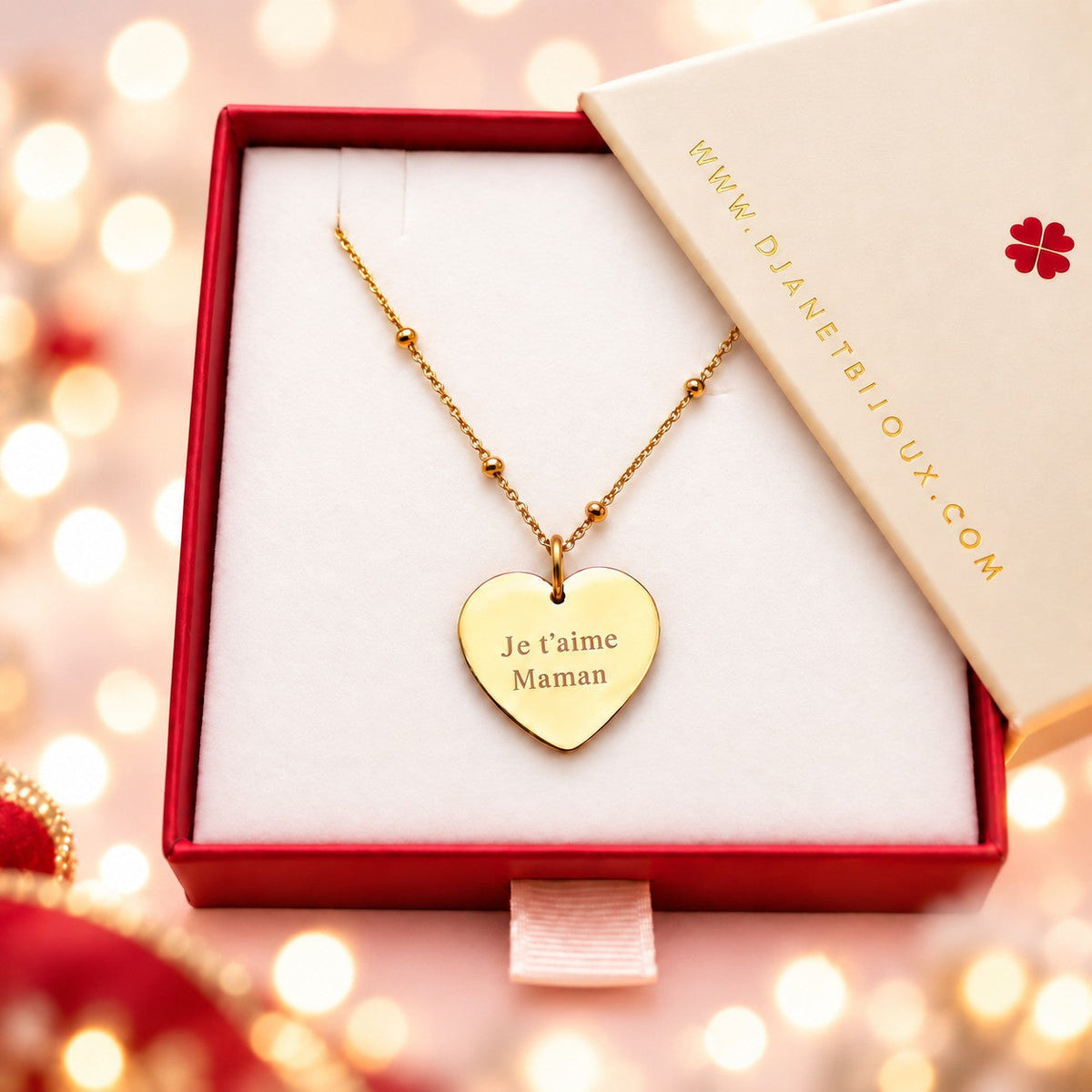
A round disc does not offer the same layout as a heart. Text that looks short when typed on a phone may take up a large area when scaled to the pendant’s actual size.
That is why you should always choose the engraving with the jewellery in mind.
Explore the possibilities in our collection of engraved necklaces for women, with discs and charms to personalise according to the design.
What should you engrave on a bracelet?
A bracelet has a slightly different relationship with its engraving: its wearer can usually see it more easily.
On a cord bracelet with an engravable disc, an initial, date or short message keeps the personalisation readable on a small surface.
An initial, a name or a date can work well on a small disc.
For families, bracelets offer another useful possibility: several charms rather than many words on one surface.
A mum could wear several small discs, each representing a child.
This keeps the composition readable and symbolically gives everyone the same space.
You can find these possibilities among our personalised engraved bracelets.
A beautiful engraving is also about its appearance
This is one of the most useful pieces of advice in this guide.
When you type a name into a personalisation box, you see text.
On the jewellery, that text becomes a graphic element.
The inscription’s length, the disc’s size and shape, the number of lines and the font all influence the result.
A short name may have more space between its letters and become a noticeable visual feature.
A longer name naturally requires a different arrangement.
A small round disc cannot carry a sentence in the same way as a larger surface.
This is why there is no universal rule such as “an engraving must always contain X characters”.
The right length depends on the jewellery.
On a 20 mm disc, for example, the arrangement can allow several characters on a line. This should not automatically be applied to smaller charms or different shapes: always follow the chosen design’s options.
The simplest rule is: the smaller the surface, the more concise the engraving should be.
An example makes the difference clearer: “Always” has six characters, while “You & me” has eight including both spaces. Yet those inscriptions do not occupy exactly the same width in a given font. Character count is a guide rather than a layout guarantee; the stated limit and the design’s options take priority.
The heart necklace linked above offers a small 13 × 13 mm heart and a larger 18 × 20 mm heart, with three fonts and front and back engraving. These outside dimensions do not mean the entire surface is engravable. Compare the design’s examples before choosing the size for your inscription.
How should you choose an engraving font?
Two pieces carrying exactly the same name can have a different character depending on the font.
A simple, regular typeface gives a more contemporary effect.
A more decorative script can feel softer and recall handwriting.
Do not choose a font just because it looks pretty when shown large.
On a small disc, legibility matters.
The longer the inscription, the more important it is to choose a font whose letters stay distinct when reduced.
Before confirming, consider the whole combination:
pendant size + text length + number of lines + font.
Together, these determine the result.
Why does diamond-point engraving have a particular appearance?
At Djanet Bijoux, engraved personalisations use diamond-point engraving.
Diamond-point engraving is mechanical: a diamond point traces directly into the surface of the metal. It works differently from marking that relies on heat.
The resulting engraving is fine, light-catching and tone on tone, without aiming for a blackened effect.
This is useful to know before ordering, because diamond-point engraving does not read quite like black printed lettering.
It reacts to light.
Depending on the jewellery’s orientation, your viewing angle and the lighting, the engraved lines can appear brighter or more subtle.
This subtle effect gives diamond-point engraving its elegant appearance.
For a fuller explanation of the techniques, we have a guide to jewellery engraving: diamond-point or laser, which should you choose?
How do you choose an engraving? Try this simple test
If you still have several ideas in mind, do not immediately search for the perfect wording.
First ask yourself what you want to represent.
To represent a person, consider their name or initial.
To preserve a moment, a date may be the better choice.
To express a feeling, look for a word or short message.
To represent several people, consider initials or separate charms rather than a long series of names on one small disc.
And if you want the meaning to stay private, consider a date, initials or a message on the back.
At this point, the choice usually becomes much easier.
Mistakes to avoid before confirming your engraving
The first is also the most important: never confirm a personalisation without reading it carefully.
Check a name letter by letter and a date digit by digit. Also check accents, capital letters, punctuation and spaces.
If you choose Roman numerals, check their transcription.
If the design allows front and back engraving, review what should appear on each side separately.
If useful, prepare two separate lines in your draft: “Front: …” and “Back: …”, then copy each inscription into its intended field without including those labels in the engraving text. If you want nothing behind and the option allows it, leave the back blank. For a request outside the offered choices, ask before ordering rather than assuming every detail of a note can be made.
Another mistake is insisting on fitting an overly long text onto a small surface. Making the characters too small can affect the balance and legibility of the personalisation.
Finally, be wary of chasing “the most original idea”.
Personalised jewellery does not need to impress other people.
It needs to mean something to you.
What if you really cannot decide what to engrave?
Return to the person or the memory, rather than the jewellery.
Which name comes to mind straight away?
Which date do you know by heart without needing to look it up?
Which word do you actually use when speaking to that person?
Which memory would you like to keep with you?
And above all: if nobody else would ever see this engraving, what would you choose?
The answer to that last question is often the most revealing.
A successful engraving does not have to be spectacular.
It can be tiny.
It can be hidden.
It can be understood by just one person.
If a few letters bring back a face, a date, a moment or a feeling, they have done their job.
That is the difference between jewellery that is simply personalised and jewellery that truly tells your story.
Explore our personalised engraved jewellery, our personalised necklaces and our personalised bracelets to imagine the piece that will tell yours.
Planning a Christmas gift? Discover our 12 personalised jewellery gift ideas for Christmas to choose a design and personalisation that the recipient will enjoy.
Jewellery engraving ideas: frequently asked questions
What can you engrave on jewellery?
Depending on the design, you can engrave a name, initials, a date, a word, a short message or certain symbols. The shape and available surface of the chosen piece mainly determine what is possible.
Which word should you engrave on jewellery?
A short, personal word can work particularly well: a nickname, a word connected to your story or an expression with a special meaning. “Always”, “Us”, “Free”, “Mum” and “Family” can offer inspiration, but a word that belongs to your own story will make the engraving more personal.
What should you engrave on jewellery for Mum?
Her children’s names or initials can carry special meaning. Their birth dates are another choice. Where the design allows it, front and back engraving can combine a name with a date.
What should you engrave on a necklace?
A name, initials, a date or a few words can work well on a disc or pendant. The inscription’s length must suit the pendant’s size and shape.
What should you engrave on a bracelet?
An initial, name or date can be engraved on a bracelet disc. To represent several children or family members, individual personalised charms can also distribute the names or initials across separate surfaces.
What should go on the front and back of a pendant?
A simple arrangement places a name or initials on the front and a date or more private message on the back. You could also place a word on the front and a date behind. Avoid unnecessarily crowding either side.
How many characters can you engrave on jewellery?
There is no universal number. Capacity depends on the jewellery’s size and shape, the font, the number of lines and the layout. Always check the possibilities shown for the chosen design.
Which font should you choose for an engraving?
The font should suit the style you want while remaining readable. The longer the text and smaller the surface, the more important legibility becomes. Choose it with both your words and the jewellery’s actual dimensions in mind.
What is the difference between diamond-point and laser engraving?
Diamond-point engraving is mechanical, using a diamond tip to trace the metal. A laser uses a different process involving a laser beam, so the visual effects can differ. For more detail, read our guide Jewellery engraving: diamond-point or laser, which should you choose?