
Jewellery engraving: diamond-point or laser, which should you choose?
Engraving jewellery gives it a unique dimension. A name, a date, initials, a meaningful word or a few characters understood only by you can turn a pendant, necklace or bracelet into a piece with a story.
But different engraving techniques produce different results.
Diamond-point, laser or mechanical engraving: which method should you choose to personalise jewellery? The result depends in particular on the metal, finish, size of the piece and the effect you want.
At Djanet Bijoux, we chose diamond-point engraving because we wanted to preserve the jewellery's elegance. On our gold-tone pieces, we prefer a fine line that plays with the light to a strongly contrasting black mark. The personalisation remains present without overshadowing the piece.
In this guide, we explain the differences between diamond-point and laser engraving, their respective advantages and what to consider before choosing your personalised engraved jewellery.
Explore our collection of personalised jewellery to engrave
 Discover the disc and initial necklace
 Discover the disc necklace to engrave
 Discover the engraved necklace with birthstone
 Discover the engraved zodiac bracelet
What is jewellery engraving?
Engraving means inscribing text, a design or a symbol durably into the surface of a piece of jewellery.
It lets you personalise jewellery with, for example:
- a name;
- initials;
- a date of birth;
- the date you met or married;
- a meaningful word;
- a short phrase;
- a star sign;
- a symbol;
- your children's initials;
- a personal message on the front or back of a disc pendant.
Engraving can be carried out in different ways: by hand, mechanically or with a laser.
The technique directly influences line fineness, contrast, engraving depth and the final appearance.
 Discover the disc and mother-of-pearl heart necklace
What is diamond-point engraving?
The diamond-point engraving technique is a form of mechanical engraving used particularly for jewellery and small metal pieces.
It uses a diamond tip to incise the metal surface very finely along a previously defined path.
Unlike a laser, this technique does not use a light beam. Engraving takes place through direct contact between the tip and the jewellery.
The diamond creates an extremely fine line that catches the light. Depending on the viewing angle, the inscription can appear more or less reflective.
This delicate, subtle and luminous appearance is what gives diamond-point jewellery engraving its charm.
At Djanet Bijoux, each personalisation is carefully carried out in our workshop near Aix-en-Provence, before each order is prepared and dispatched.
How does diamond-point engraving work?
Before engraving, several details need to be established precisely:
the size of the piece, text placement, character count, alignment and any design.
The jewellery is then accurately positioned on the engraving machine.
The diamond tip follows the programmed path, progressively engraving the surface.
The quality of the result depends greatly on the settings. On a small disc, a few tenths of a millimetre can make the difference between a balanced engraving and overcrowded text.
This is why every personalisation must suit the actual dimensions of the piece.
At Djanet Bijoux, certain disc pendants are available in different diameters to accommodate the inscription you want.
A 20 mm disc, for example, can accommodate more characters than a smaller design while remaining easy to read.
What is laser jewellery engraving?
The laser engraving technique uses a concentrated beam of light to modify the surface of the material.
Depending on the technology, laser power, metal and settings, the laser can:
- mark the surface;
- change its colour;
- remove part of the coating;
- create contrast;
- or remove a very small amount of material.
The result can therefore vary considerably.
On some surfaces, laser engraving is dark and highly contrasting. On others, it can be much more subtle.
Laser engraving also offers very high precision and works particularly well for complex designs, logos and detailed motifs.
Diamond-point or laser engraving: what differs on jewellery?
The difference between diamond-point engraving and laser engraving lies both in the process and in the appearance of the finished piece.
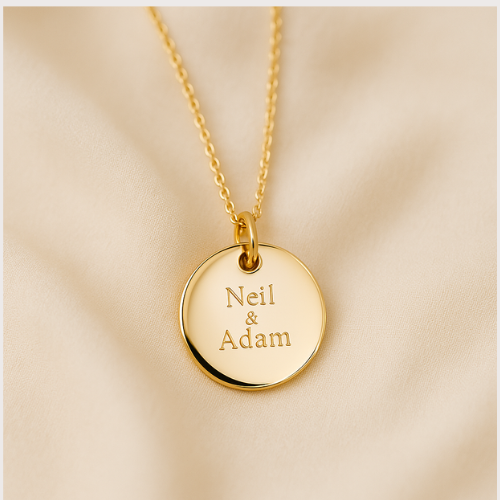
The diamond-point method is mechanical: a diamond tip incises the metal surface directly, without applied heat. It creates a fine line that catches the light, with a tone-on-tone, luminous and elegant appearance.
The laser method, meanwhile, uses a concentrated beam that heats the metal or coating surface. Depending on the material, coating, laser source and settings, it can produce black, white or grey marks, or a more subtle result. A laser engraving is therefore not necessarily black.
This difference often helps distinguish the two techniques visually:
- diamond-point engraving: a fine, luminous, subtle and refined line;
- laser engraving: contrast and colour vary with the surface, source and settings.
On gold-tone jewellery, diamond-point engraving therefore retains a subtler appearance closer to traditional jewellery aesthetics, while a laser can create stronger contrast, depending on the material and settings.
Comparison table
| Feature | Diamond-point engraving | Laser engraving |
|---|---|---|
| Process | Mechanical diamond tip | Laser beam |
| Applied heat | No | Yes |
| Action | Incises the surface | Thermal action on the surface |
| Mark colour | Tone on tone, reflective depending on the light | Black, white or grey depending on the material, source and settings |
| Appearance | Fine, luminous and subtle | Variable contrast depending on the surface and settings |
| Appearance on gold-tone jewellery | Refined and subtle | More or less visible marking depending on the desired result |
| Fine text | Very suitable | Very suitable |
| Complex designs | Depends on the machine's capabilities | Extensive graphic freedom |
Neither technique is therefore always better than the other.
The choice mainly depends on the desired appearance, material and type of personalisation.
For our personalised creations, we chose diamond-point engraving because it particularly suits the Djanet Bijoux aesthetic: fine, elegant and subtle.
Why choose diamond-point engraving for personalised jewellery?
Diamond-point engraving offers several advantages when used on jewellery.
A particularly fine engraving
The diamond tip creates precise lines, even on relatively small surfaces.
This is particularly useful for personalised disc pendants, small pendants and jewellery that calls for delicate engraving.
A luminous appearance
Diamond-point engraving does more than create a visible inscription.
The engraved line reflects light differently from the surrounding surface, giving it a slight shine.
The engraving can seem subtle from certain angles, then become much more visible as the jewellery moves.
Elegant personalisation
On fine or minimalist jewellery, an engraving with very strong contrast can sometimes dominate the piece.
Diamond-point engraving offers a subtler result.
This makes it particularly suited to jewellery you want to wear every day.
Work adapted to small surfaces
Jewellery often offers very little space.
A disc just a few millimetres across therefore needs extremely precise engraving.
Diamond-point engraving achieves a very fine result on this type of surface.
Can stainless steel jewellery be engraved?
Yes.
The material stainless steel is well suited to personalisation when worked with an appropriate technique and settings.
At Djanet Bijoux, the relevant designs are made from premium stainless steel with a gold-tone PVD finish. Check the product page for the piece's precise composition and finish.
The engraving must therefore be precise enough to produce a clear result without compromising the jewellery's aesthetic.
This is one reason why we favour a fine, carefully controlled engraving.
Our jewellery also meets the applicable requirements of the European Union's REACH regulation, particularly regarding nickel release.
Which jewellery can be engraved?
Many pieces can be personalised, provided they have a suitable surface.
At Djanet Bijoux, engraving is offered on selected designs chosen specifically to accommodate elegant personalisation.
Personalised disc necklace
A personalised necklace is probably one of the most popular forms of engraved jewellery.
The disc provides space for a name, an initial, a date or a personal message.
Worn close to the heart, it also gives the jewellery particular symbolic meaning.
Discover our personalised necklaces
Engraved bracelet
A personalised bracelet lets you wear a date, a name or a discreet message on your wrist.
Diamond-point engraving is also available on our cord bracelet with a 15 mm disc: find this design among our personalised cord bracelets, with complimentary engraving on the front and back.
It is also a lovely gift for a birthday, a new baby, a celebration or simply to share a personal message.
Discover our personalised bracelets
Personalised disc pendant
An engraved disc pendant remains a classic choice for personalisation.
Depending on the design, it can be worn alone or paired with a chain, a natural stone or another pendant.
Engraving can be placed on the front and, where the design permits, on the back.
What can you engrave on jewellery?
The possibilities are almost endless, provided you respect the available dimensions.
The most common inscriptions include:
names, initials, important dates and meaningful words.
But you can also choose something more personal.
A few examples:
- Léa
- A + M
- 12.06.2025
- Mum
- Love
- Always
- Together
- Forever
- My star
- My loves
- an initial;
- a symbol;
- a star sign;
- your children's initials;
- a nickname;
- a family saying;
- a few words whose meaning is known only to the wearer.
Engraving creates jewellery with a story of its own. To find your inscription, explore our jewellery engraving text ideas.
Which engraving should you choose for meaningful jewellery?
It all depends on the story you want to tell.
For very minimalist jewellery, a single initial can be enough.
For a new baby gift, the child's name or date of birth is particularly popular.
For a couple, initials, the date they met or a wedding date give the jewellery a more intimate meaning.
And for a family gift, children's initials or a meaningful word can turn a disc pendant into a lasting reminder.
Can you engrave the front and back of a pendant?
Depending on the design, yes.
The option of front and back engraving allows even fuller personalisation.
For example, you could choose:
a name or initial on the front;
and a date or a more personal message on the back.
This also lets you keep some details more private.
The front can stay very simple, with the most intimate message engraved on the reverse.
How many characters can you engrave on jewellery?
There is no universal character limit.
It depends on:
- the size of the piece;
- the available surface;
- the chosen font;
- the number of lines;
- the character size.
The longer the text, the smaller the letters need to be.
To keep the engraving elegant and clearly legible, a short text is often the best choice.
On a disc pendant, a name, a few initials or a date generally look more balanced than a long sentence.
Does diamond-point engraving last?
Yes.
Diamond-point engraving is made directly into the surface of the piece.
It is therefore not a printed layer added on top of the metal.
This gives the engraving lasting durability.
As with any jewellery worn daily, the surface can naturally develop small signs of wear over the years, but the inscription itself does not disappear in the way a simple printed mark might.
How should you care for engraved jewellery?
Engraved jewellery needs the same care as ordinary stainless steel jewellery.
To preserve its shine, we particularly recommend:
- avoiding prolonged contact with chemicals;
- removing jewellery before particularly abrasive activities;
- cleaning it regularly with a soft cloth;
- storing it separately when you are not wearing it.
Gentle cleaning also helps preserve the luminosity of the engraved lines. Find our advice on cleaning and caring for gold-tone stainless steel jewellery.
Why give personalised jewellery?
Some jewellery is chosen simply for its appearance.
Other pieces are chosen for what they represent.
Personalisation turns jewellery into a keepsake.
A pendant bearing a child's name, a wedding date, the initials of someone dear or a few personal words has more than aesthetic value.
It has emotional value.
This makes personalised engraved jewellery a particularly appreciated gift for:
- a new baby;
- a birthday;
- Mother's Day;
- a wedding;
- the anniversary of meeting;
- Christmas;
- a farewell;
- or simply to delight someone important to you.
Engraved jewellery to tell your story
An engraving does not need to be understood by everyone.
Some of the loveliest personalisations are precisely those whose meaning remains private.
A date, two initials, a nickname or a few words can be enough to recall a person, a story or a special moment.
This is also what makes every Djanet Bijoux personalised piece unique.
The design may be the same.
But the engraving tells a different story.
How do you personalise a Djanet Bijoux piece?
Personalisation takes place directly when you place your order.
1. Choose your jewellery
Select the necklace, bracelet or disc pendant you want to personalise from the available designs.
2. Choose your engraving
Enter the name, initials, date, word or symbol you want engraved, according to the options offered for the design.
3. Choose your font
Next, select the font that best suits the style you want for your jewellery.
A fine, elegant font produces a delicate result, while bolder lettering makes the personalisation more visible.
Choosing the font is part of creating the piece: the same name can look very different depending on the lettering.
4. Choose front and back engraving where available
Some designs allow front and back engraving. You can, for example, put a name or initials on the front and add a date or a more personal message on the reverse.
5. Check your personalisation
Before confirming your order, carefully check:
the engraving text, spelling, chosen font and any front and back options.
6. Your jewellery is engraved in our workshop
Your personalisation is then prepared and diamond-point engraved in our workshop in France.
Each composition is adapted to the size of the piece to produce a balanced, legible and elegant result.
7. Your jewellery is carefully prepared
Once engraved, the jewellery is checked and carefully placed in its presentation box, ready to give as a gift… or to accompany you every day.
Discover our personalised jewellery
FAQ — All about jewellery engraving
What is the best technique for engraving jewellery?
No single technique suits all jewellery. Diamond-point engraving gives a particularly fine, luminous result, while a laser offers a wide variety of marks and designs. The choice depends on the metal, finish and desired effect.
What is the difference between laser and diamond-point engraving?
The diamond-point method works mechanically, using a diamond tip to incise the metal surface without heat. It produces a fine, luminous, tone-on-tone line.
The laser method uses the heat of a concentrated beam. Its appearance depends on the material, coating, source and settings: the mark can, for example, be black, white or grey.
The choice therefore depends mainly on the look you want: a luminous, tone-on-tone line with diamond-point engraving, or a laser result whose contrast and colour depend on the surface and settings.
Does diamond-point engraving wear away?
The engraving is inscribed into the surface of the piece. It therefore does not wear away like a printed layer. Its appearance can nevertheless change slightly with the jewellery's natural wear.
Can stainless steel be engraved?
Yes. Stainless steel can be engraved using different techniques, including mechanical and laser engraving.
Can gold-tone jewellery be engraved?
Yes, provided the technique suits the metal and its coating. The final result depends in particular on the finish and engraving depth.
How many letters can you engrave on a disc pendant?
That depends on the pendant's diameter and the font used. The shorter the text, the easier it is to keep the characters legible and elegant.
Can you engrave a symbol?
Yes, when the symbol is compatible with the engraving machine and simple enough to remain legible at the jewellery's size.
Can both sides be engraved?
Some designs allow personalisation on the front and back. This is particularly useful for combining a name with a date or adding a more personal message on the reverse of the pendant.
Where is Djanet Bijoux jewellery engraved?
Djanet Bijoux personalised jewellery is engraved in our workshop in France before being prepared and dispatched.