
Malachite meaning, properties and natural stone jewellery

Malachite’s shades of green and distinctive patterns make it a fascinating natural stone with a striking place in jewellery.
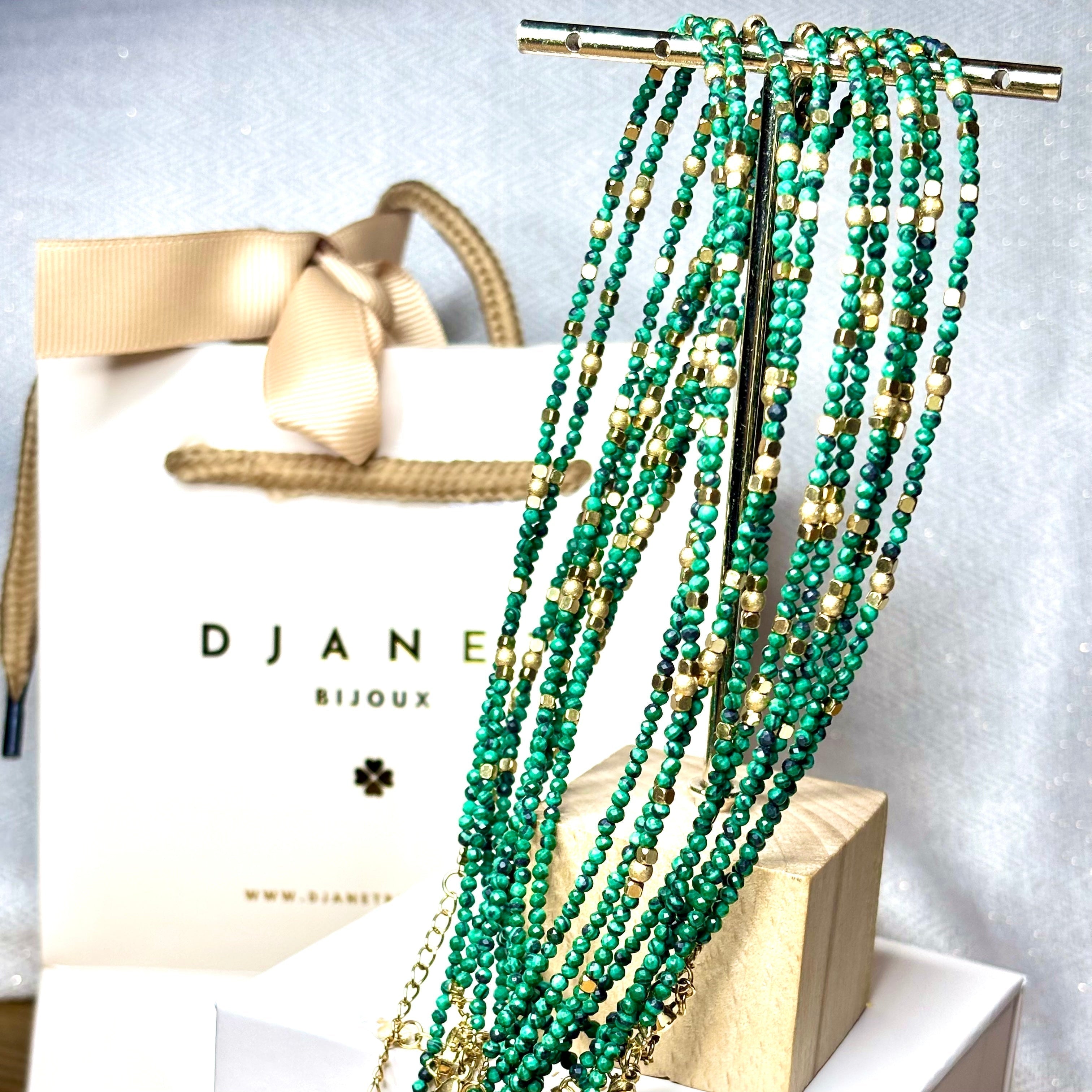
Used for centuries, it appeals today for its rich appearance and the elegant contrast it creates with gold-tone stainless steel jewellery.
Explore our malachite jewellery collection, combining natural colour and gold-tone details.
Why is this stone so sought after? How do you wear and care for it? This guide explores malachite’s appearance, symbolism and place in jewellery.
What catches the eye first is not a flat colour but a pattern. Lighter lines cross a deep green, curves gather around a centre, then the pattern changes near the edge. That graphic presence explains why a small malachite can give character to otherwise simple jewellery.
What is malachite, and what is its history?
Malachite is a green ornamental stone, often recognised by its bands and concentric patterns. Used since antiquity for jewellery and decorative objects, it has long been valued for both appearance and symbolism.
Its name is linked to the Greek malakhé, meaning mallow, in reference to the green of the plant’s leaves. The often-repeated link with “softness” should not replace this botanical explanation.
Copper gives its colour; formation creates its patterns
Malachite is a copper carbonate hydroxide. It can form as copper minerals alter in the presence of carbonate-rich water. Banded masses reveal their patterns when cut and polished. France’s National Museum of Natural History describes this formation and holds specimens showing the decorative role of those bands.
Its hardness is around 3.5 to 4 on the Mohs scale. This describes resistance to scratching rather than overall toughness. A beautiful polished surface can therefore still need care. In jewellery, how the mount protects the stone matters as much as its pattern.
That history also explains its use in objects far larger than a pendant: boxes, decorative pieces and panelling. Banded Russian malachite has been used in monumental interiors. Jewellery offers a more intimate version: a few millimetres retain that language of lines and greens.
Malachite meaning and traditional associations: what do they represent?
In crystal-healing beliefs, malachite is sometimes called a “stone of transformation” and given several symbolic associations:
- Emotional symbolism: some people associate it with confidence and moving through a personal change
- Energy-related beliefs: some traditions describe it as a symbol of protection from negative energies
- Calming symbolism: its green colour can evoke a personal idea of balance
These meanings belong to beliefs and personal practices; they do not establish a therapeutic effect of the stone. Jewellery can recall an intention, a person or an important life stage without being presented as a way to treat a health problem.
For a gift, that distinction changes the choice. You might give malachite because its green suggests a fresh start or because the recipient enjoys its patterns. Meaning then comes from the thought behind the gift, without promising that the mineral will change emotions or wellbeing.


Why choose malachite jewellery?
Malachite jewellery appeals for its distinctive character and natural elegance.
- Variations in each stone contribute to a distinctive piece of jewellery
- Its rich green colour draws attention
- It contrasts beautifully with gold-tone stainless steel
As a necklace, bracelet or pair of earrings, malachite brings a natural, expressive detail to an outfit.
Explore our malachite necklaces and gold-tone steel bracelets to bring light and colour to your style.
How should you wear malachite?
Malachite has a strong visual presence and can give an outfit a clear focal point:
- With gold tones, for an elegant contrast
- As the main detail, in a necklace or pendant
- Layered with other jewellery, for a more detailed look
It works particularly well with neutral colours such as white, beige and black.
Begin with one green piece and leave room around it. A necklace over a light shirt highlights the pattern; earrings bring colour near the face; a bracelet adds a detail seen with each movement. For layering, try a simpler chain first rather than several equally noticeable pendants.
The collection offers different interpretations. The Marissa necklace has a round 17 × 17 mm pendant on a 50 cm chain with a 5 cm extension. Nina hoops carry a round 8 × 8 mm stone. These design-specific measurements show why the same stone can create a central focus or a smaller accent. Compare dimensions and worn photographs, not just the mineral’s name.
Which forms can malachite take?
Malachite can be worked or presented in different forms:
- Polished: cabochons and beads used in jewellery
- Rough: mineral specimens, decorative pieces or objects used in symbolic practices
- Inlaid: in some objects and accessories
A domed, polished surface shows the bands differently from a small irregular chip. The Marcy charm, for example, combines malachite chips with a gold-tone clasp for a compatible attachment. It aims for a different effect from a round disc. Choose the shape for the movement and volume you enjoy, checking that the construction is compatible.
Where is malachite found?
Malachite occurs in several regions, including:
-
- Democratic Republic of the Congo
- Namibia and Zambia
- Russia, particularly the Urals
- Australia and the United States
This list is indicative and does not identify the origin of a particular piece of jewellery. A source country alone is not a quality grade. Knowing where a sold stone comes from requires traceability information for that piece; its patterns or colour cannot establish the origin with certainty.


How can you recognise genuine malachite?
Several observations can prompt useful questions, but none alone proves authenticity:
- Bands and patterns: compare their appearance without treating irregularity as proof
- A cool feel: other materials can also feel cool
- Weight: stone size, its mount and other materials affect the impression
Imitations in resin or plastic exist. Ask for a clear material description, and seek a gemmologist’s opinion if you need a reliable identification.
A photograph can show colour and pattern, but cannot replace identification. Ask whether the material is natural stone, a reconstructed composite or an imitation, and whether a treatment is declared. Avoid home tests involving scratching, heat or acid: they can damage the jewellery without giving a reliable conclusion.
How do you choose malachite for jewellery?
To choose a piece you will enjoy wearing:
- Choose patterns you enjoy, rather than a supposed universal ideal
- Check the visible condition and avoid damaged or cracked areas
- Look for a careful finish and a mount suited to the piece
Djanet Bijoux’s malachite designs are chosen for their visual character and colour. Check the exact material, dimensions and construction on each product page.
Look beyond the stone to the whole piece: chain length, pendant size, fastening and room for movement. Malachite in a bracelet may meet a table or other jewellery more often than a small pendant. Match the choice to your habits rather than simply seeking the largest stone.
How should you care for malachite jewellery?
Malachite needs gentle care, including when paired with steel:
- Avoid soaking and exposure to chemicals
- Begin with a soft, clean, dry cloth
- Store separately, away from knocks and damp
Avoid acidic cleaners, abrasives, steam and ultrasonic cleaning. Remove the piece before activities involving knocks or cleaning chemicals. A steel mount does not automatically make the stone suitable for the same cleaning methods as bare metal.
After wearing, wipe gently without prolonged rubbing. If a mark remains, ask for advice on the design before adding a cleaner or immersing it. Store the dry piece in a separate compartment or pouch. This also helps protect its polished surface from rubbing against harder jewellery.
For more advice on the whole piece, read our gold-tone stainless steel jewellery care guide.


What determines malachite’s value?
Several factors matter:
- The appearance and composition of the patterns
- Colour
- Size
- Finish
There is no single price per stone. For finished jewellery, compare the materials, stone size, mount and workmanship, rather than inferring quality from price alone.
Which zodiac signs are associated with malachite?
Some symbolic traditions associate malachite with:
- Scorpio
- Capricorn
- Taurus
These correspondences vary between traditions and are not mineralogical properties. You can enjoy malachite without belonging to any of these signs. Colour, shape and your own story are equally valid starting points for personal jewellery.
Frequently asked questions about malachite
Can malachite go in water?
For jewellery, avoid soaking and follow the complete design’s instructions. Consider the stone, metal and construction together. A “purification” ritual should not be confused with a cleaning method suited to the material.
Do weight and touch prove malachite is genuine?
No. Those impressions depend on several factors, and other materials can feel cool or heavy. A transparent material description and, where needed, gemmological identification provide more reliable information.
What benefits are attributed to malachite?
Some beliefs symbolically associate it with transformation, protection or balance. These are not demonstrated therapeutic effects. For jewellery, you may value that personal meaning without expecting an effect on health.
For mineral formation and properties, see the entries from France’s National Museum of Natural History and Sofia’s National Museum of Natural History.
Choosing malachite jewellery for its colour and character
Malachite combines a distinctive natural appearance with a rich symbolic history. Beside gold-tone stainless steel, its green colour creates an expressive detail. Choose it for the patterns, the design and the meaning you personally give it.
Explore Djanet Bijoux’s malachite jewellery and find the design you will enjoy wearing.