

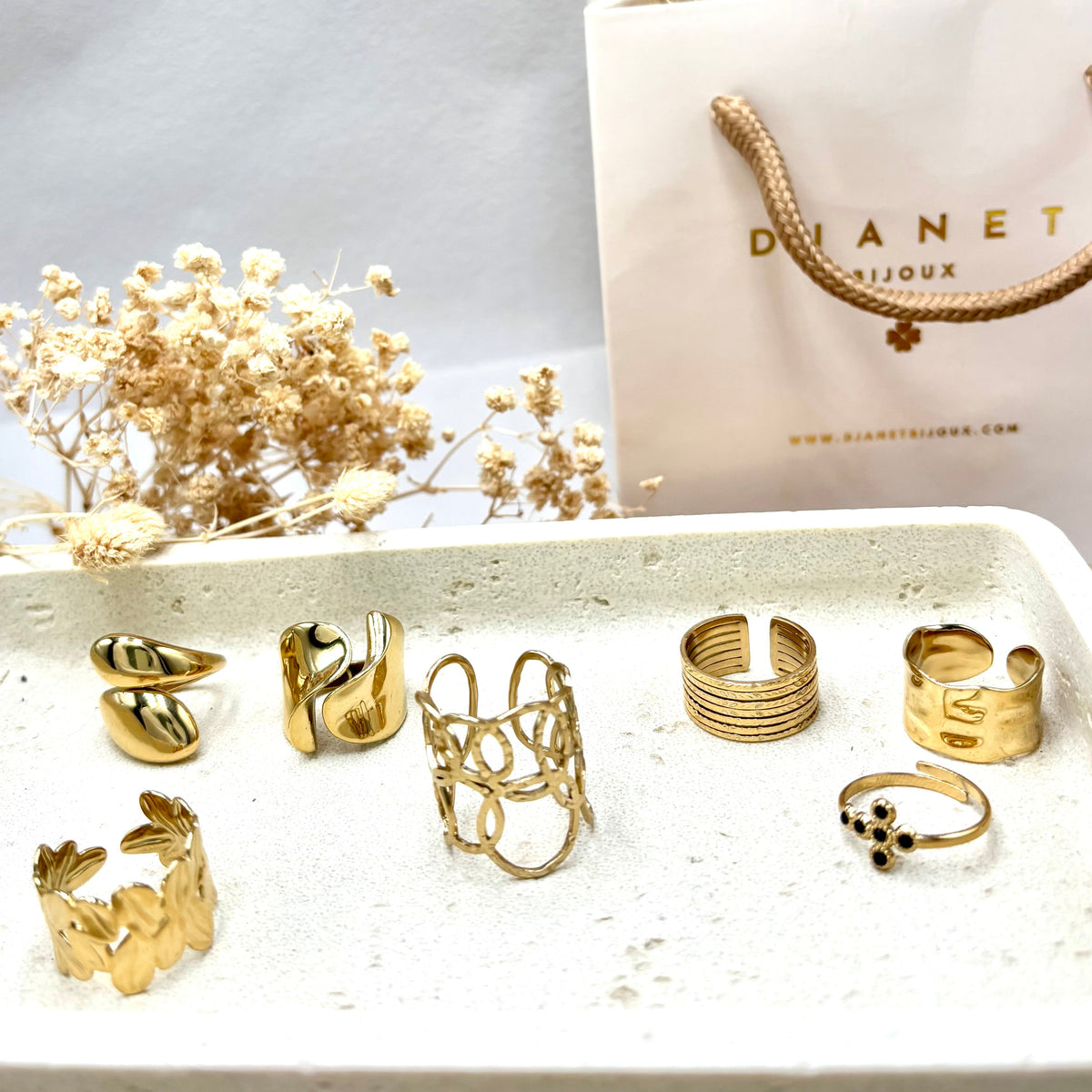
Gold-tone stainless steel rings: choosing style and fit
A gold-tone stainless steel ring can add a discreet detail or become the focal point of an outfit. Width, relief and motif shape change its presence on the hand as much as its colour does.
To choose, consider the style you enjoy, the fit and the care advice. Explore our gold-tone stainless steel ring collection and the useful pointers in this guide.
You can love a ring at first sight yet hesitate when imagining it on your own hand. A useful starting point is very practical: do you want a band you almost forget you are wearing, or a shape you enjoy looking at whenever you move your fingers? Both preferences are valid and may lead to different designs.


Why choose a gold-tone stainless steel ring?
Stainless steel provides a corrosion-resistant base appreciated for jewellery worn regularly. It allows fine or more sculptural shapes, combined with a gold-tone finish and, depending on the design, decorative elements.
In a gold-tone ring, steel forms the base while the finish provides its colour. PVD is one method used to deposit that coating. Look at the stated composition, the design details and the care advice: together, these give you a clearer picture of the jewellery than its shade of gold alone.
To understand the difference between base metal and finish, read our stainless steel jewellery guide. Colour alone does not make a gold-tone steel ring comparable to a solid gold ring.
If you are comparing finishes, our stainless steel or gold-plated ring comparison explores the useful criteria for jewellery worn on the hand.
Fine or wide ring: which style feels like you?
Fine rings for a discreet detail
A fine gold-tone ring can be worn alone or with other bands. Leave a little space between motifs and check that the combination does not restrict finger movement. Stacking works best when it remains comfortable.
Discretion is not only about the metal’s thickness. A small smooth motif, a ridged band and an openwork design reflect light differently. Notice what you enjoy in your usual jewellery: an uninterrupted line, a little shine or a texture seen up close. This detail helps you choose beyond the impression of a tightly cropped photograph.
Wide rings for a stronger statement
Open, domed or openwork shapes draw more attention. Valene has an open wavy line; Janna intertwines circles; Esmeralda places two smooth domed shapes opposite one another. Check each product page’s photographs and measurements to judge its volume.
To judge proportions, distinguish decorative height from finger size. Pippa, Valene and Esmeralda list heights of 10, 19 and 22 mm respectively. These measurements describe the space occupied by the design, not an internal diameter. A 22 mm shape may therefore cover more of the finger without meaning its band is intended for a wider finger.
Comparison with a ring you already wear is often more useful than labels such as “wide” or “fine”. Look at the motif’s height, the space near the joint and the way the edges work with your movements. You do not have to choose the quietest design to feel comfortable; its volume simply needs to suit you.


Textures and motifs to make the look personal
A hammered or ridged surface brings relief to the gold-tone finish. Pippa combines textured and openwork lines, Marge has floral motifs, and Mira has a hammered finish. For contrast, Maria features a cross motif with cubic zirconia.
Choose according to your taste, without a rule imposed by your hand shape. A visible motif can stand on its own; a quieter band can complement your other jewellery.


Adjustable gold-tone steel rings: finding a comfortable fit
Our rings are adjustable. There is no size to select for these designs. That flexibility does not mean the same ring fits every finger: shape and volume can affect comfort.
- Adjust the design gently, without distorting it or putting force on the ornaments.
- Check that it stays in place without pressing into the finger.
- Bend your fingers and move your hand to check that the motif does not interfere with your gestures.
- Avoid opening and closing the band every time you wear it or repeatedly changing fingers.
How can you tell whether an adjustable ring fits?
First look at it on a relaxed hand: the motif should stay where you like it, rather than constantly falling to one side. Then try a few simple movements. A wide design can feel comfortable when it leaves the joint free; a fine ring can feel awkward if an edge or motif sits in the wrong place. The style name alone cannot predict how it will feel.
Gently put the ring on and take it off to check that both movements remain easy. Look for a fit that follows your hand without needing to keep repositioning the jewellery. To explore proportions for your fingers, our guide to choosing rings for your finger shape offers further ideas. It helps you assess volume, while trying the design remains essential for comfort.
For a gift, a ring the recipient already wears offers a useful reference. Notice its width, relief and the space it takes up on the hand. An adjustable fit helps with the choice, but the pleasure of returning to a familiar shape — or trying a new design — also makes the gift personal.
Once you have found the right fit, keep that opening as far as possible for future wear. Adjusting a ring helps it sit well on one finger; opening and tightening the band every morning would put unnecessary strain on its structure. Handle the sides intended for adjustment, keeping pressure away from petals, raised details and stones.
Before deciding, try movements you often make: holding a pen, gripping a handle or putting on clothing. A ring may look well placed on a still hand yet feel less pleasant in motion. This simple check is part of choosing, just as much as the motif.
Which details should you check when choosing a ring?
Check the stated composition, motif dimensions, edge finish and the way ornaments are held. A warmer or softer gold tone alone does not determine quality; appearance and preference matter too.
For sparkle, compare photographs of the decorated designs. Our cubic zirconia guide explains this synthetic stone and how it differs from diamond. Do not infer composition from visual resemblance alone.


How to combine rings and gold-tone jewellery
Start with one main piece: a wide ring, a floral motif or a texture you enjoy. You can add a fine band on another finger, then check that the pieces do not constantly knock against one another.
A sculptural ring can accompany a fine gold-tone necklace. A group of quieter rings can work with a more noticeable gold-tone bracelet. You can echo a texture without looking for a perfectly matching set.
A floral motif, hammered surface or openwork circles can set the tone on their own. To explore combinations further, our guide to choosing and styling gold-tone rings develops contrasts of volume and outfit ideas. Here, focus on how comfortable your chosen design feels and the freedom it leaves for your movements.
Water, rubbing and care: useful habits
The metal’s resistance does not make its finish and ornaments unchangeable. Remove your ring before showering, swimming, sport, washing dishes and tasks involving chemicals. Hands expose jewellery particularly to rubbing and cosmetics.
Wipe with a soft cloth and store rings separately. For a suitable plain metal design, gentle cleaning with lightly soapy water may be appropriate, followed by careful drying. With mother of pearl, pearls, stones or glued elements, adapt your care and avoid soaking.
Avoid abrasives, acids and vigorous polishing on the gold-tone finish. Cleaning removes dirt but does not recreate a worn coating. Find the details in our stainless steel jewellery care guide.
Frequently asked questions about gold-tone stainless steel rings
Do I need to select a size?
No size selection is required for the adjustable designs shown here. Still check the motif dimensions and the product information: they help you imagine the ring on your hand and ask for advice about a design you like.
Can you wear an adjustable ring on several fingers?
It depends on the design and the fit you achieve. Avoid repeated opening and tightening to keep moving it from one finger to another.
Is a gold-tone PVD ring solid gold?
No. The surface finish and base metal are separate pieces of information. PVD describes the process used.
Is a wide ring necessarily uncomfortable?
No. Shape, dimensions and use matter. Check that you can bend your fingers and move your hand freely.
Can you sleep wearing rings?
Taking them off limits rubbing and catching, especially with decorated or openwork designs.
Explore our adjustable gold-tone stainless steel rings to compare shapes and choose your next design.


